
A Milk Reception Unit (MRU) is the crucial first step in a dairy processing plant where raw milk from farms or collection centers is received, checked for quality, measured, and prepared for storage or further processing.
It is designed to ensure accuracy, hygiene, and efficiency in the critical transition of raw milk from the transport vehicle to the factory's main processing line.
Key Functions of a Milk Reception Unit:
* Unloading/Intake: Receiving the raw milk from delivery vehicles (tankers or cans).
* Grading and Testing: Taking samples and performing rapid quality checks for:
* Temperature
* Fat content
* Solids-Not-Fat (SNF)
* Density (to check for possible water adulteration)
* Acidity
* Adulterants/Antibiotics (more advanced tests).
* Filtration/Sieving: Passing the milk through filters or sieves to remove physical impurities or debris.
* Air Elimination (Deaeration): Removing entrained air and foam from the milk. This is essential for accurate volume measurement and to improve pump efficiency.
* Measurement/Weighing: Accurately measuring the quantity of milk received, often done with a Weigh Bowl/Tank (for can reception) or a High-Accuracy Flow Meter with an air eliminator (for tanker reception). This data is critical for payment to farmers/suppliers.
* Pumping: Using sanitary pumps to move the milk from the reception area to the cooling or storage tanks.
* Cooling (Chilling): Rapidly chilling the raw milk, typically using a Plate Heat Exchanger, to a low temperature (usually \leq 4^\circ \text{C}) to prevent bacterial growth and preserve its quality until processing.
* Storage: Transferring the chilled raw milk into insulated Raw Milk Silos/Storage Tanks before pasteurization.
Essential Components of an MRU:
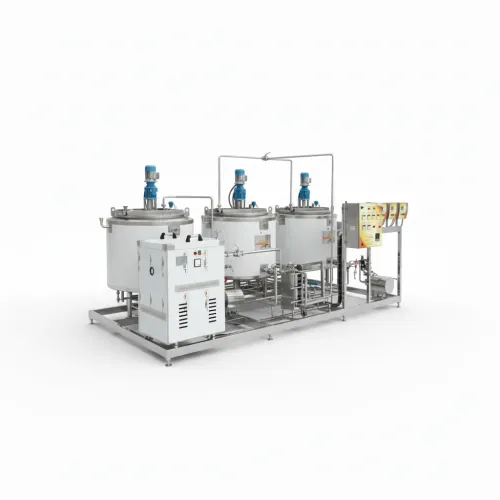
The modern, often skid-mounted, MRU system typically includes:
* Reception Bay/Dock: The area where tankers or cans are received and connected.
* Deaerator/Air Eliminator: A device to remove air bubbles from the milk flow.
* Flow Meter (or Weigh Tank): For accurate quantitative measurement.
* Filter/Strainers: To remove physical foreign matter.
* Milk Transfer Pump: To move the milk through the system.
* Plate Heat Exchanger (Chiller): For immediate chilling.
* Sampling Station: For collecting milk samples for quality testing.
* Control Panel (PLC): To automate and monitor the entire reception process.
* CIP (Clean-in-Place) Connections: The system is designed to be easily cleaned and sanitized automatically.
It is designed to ensure accuracy, hygiene, and efficiency in the critical transition of raw milk from the transport vehicle to the factory's main processing line.
Key Functions of a Milk Reception Unit:
* Unloading/Intake: Receiving the raw milk from delivery vehicles (tankers or cans).
* Grading and Testing: Taking samples and performing rapid quality checks for:
* Temperature
* Fat content
* Solids-Not-Fat (SNF)
* Density (to check for possible water adulteration)
* Acidity
* Adulterants/Antibiotics (more advanced tests).
* Filtration/Sieving: Passing the milk through filters or sieves to remove physical impurities or debris.
* Air Elimination (Deaeration): Removing entrained air and foam from the milk. This is essential for accurate volume measurement and to improve pump efficiency.
* Measurement/Weighing: Accurately measuring the quantity of milk received, often done with a Weigh Bowl/Tank (for can reception) or a High-Accuracy Flow Meter with an air eliminator (for tanker reception). This data is critical for payment to farmers/suppliers.
* Pumping: Using sanitary pumps to move the milk from the reception area to the cooling or storage tanks.
* Cooling (Chilling): Rapidly chilling the raw milk, typically using a Plate Heat Exchanger, to a low temperature (usually \leq 4^\circ \text{C}) to prevent bacterial growth and preserve its quality until processing.
* Storage: Transferring the chilled raw milk into insulated Raw Milk Silos/Storage Tanks before pasteurization.
Essential Components of an MRU:
The modern, often skid-mounted, MRU system typically includes:
* Reception Bay/Dock: The area where tankers or cans are received and connected.
* Deaerator/Air Eliminator: A device to remove air bubbles from the milk flow.
* Flow Meter (or Weigh Tank): For accurate quantitative measurement.
* Filter/Strainers: To remove physical foreign matter.
* Milk Transfer Pump: To move the milk through the system.
* Plate Heat Exchanger (Chiller): For immediate chilling.
* Sampling Station: For collecting milk samples for quality testing.
* Control Panel (PLC): To automate and monitor the entire reception process.
* CIP (Clean-in-Place) Connections: The system is designed to be easily cleaned and sanitized automatically.
Keywords